Tuesday, July 13, 2010

2010 FoxPro Lifetime Achievement Award Nominations

The FoxPro Lifetime Achievement Award honors those individuals who have contributed a great deal to the FoxPro community over the years. See http://fox.wikis.com/wc.dll?Wiki~FoxProCommunityLifetimeAchievementAward~VFP for previous award recipients.

These recipients wish to continue the award and have created a committee to select one or more recipients for 2010. The committee consists of previous recipients Whil Hentzen, Rick Strahl, Doug Hennig, Tamar Granor, and Rainer Becker, as well as Alan Griver (yag) of Microsoft and Naomi Nosonovsky representing the FoxPro community.

To submit your nominations for the 2010 recipients, please email me (dhennig AT stonefield DOT com) by August 15, 2010.

Stonefield Query 4.0 Released

We are pleased to announce the immediate release of the Stonefield Query SDK version 4.0. There are lots of new and improved features in version 4.0; see the Stonefield Query blog for details.

We have videos covering the new features in the SDK and in the Report Designer.

Wednesday, July 07, 2010

Why Community and Conferences are Important

Dave Aring of Visionpace just blogged about why community and attending conferences are important (his post is actually about solving a specific problem but the last two paragraphs are the key). Of course, he’s referring specifically to the VFP community, but I think it holds true in any community.

Friday, June 25, 2010

Gotcha with Custom Report Memberdata Attribute Names in VFP 9 SP 2

(That must be the longest blog title in history!)

I’ve been (finally) implementing VFP 9 SP2 features in Stonefield Query (version 4.0 is due to be released next week) and, while doing some final testing, ran into an error when editing a certain object in the Report Designer. The error was 1712, “Field name is a duplicate or invalid”. In tracking the error down, it occurred in the XMLStrToCursor method of _FRXCursor, one of the report helper classes in the FFC. The statement causing the error was ALTER TABLE … ADD COLUMN … It’s not actually a table that columns are being added to but a cursor. The weird thing is that the columns being added didn’t exist in the cursor, so they certain weren’t duplicates.

I tweeted about this and Frank Perez Jr. responded “I think you also get that error if the field name is invalid (i.e. more than 10 characters in a free table).” Sure enough, that was the problem. Even though cursors can have field names longer than ten characters, ALTER TABLE can’t handle them, and given that there’s no ALTER CURSOR command, we’re stuck with it.

What lead to the error was that I added custom report memberdata to the specific object causing the problem. The custom memberdata had an attribute named “adjustwidth”, which is more than ten characters long. Changing it to “adjwidth” solved the problem. So, important safety rule (channelling Venkman here): don’t use names more than ten characters for your custom report memberdata attributes.

Thanks to Frank for pointing me in the right direction. Another reminder of the usefulness of Twitter.

Thursday, June 24, 2010

2010 Ceil Silver Ambassadors

Yes, that title is plural: thanks to the generosity of the VFP community, we have enough money to bring two developers to Southwest Fox as 2010 Ceil Silver Ambassadors. Geek Gatherings is pleased to announce that César Chalom and Bernard Bout have been selected as the ambassadors for Brazil and Australia, respectively. We are very excited that César and Bernard can attend Southwest Fox 2010 and know that many attendees are looking forward to meeting them in person.

Tuesday, June 15, 2010

Southwest Fox on the FoxShow

Andrew MacNeill interviews Rick Schummer, Tamar Granor, and I about Southwest Fox 2010 in FoxShow #65. As usual, it was a fun interview and he asked lots of interesting questions about what attendees can expect to see.

Friday, June 04, 2010

New VFP 9 SP2 and Sedna Book Available

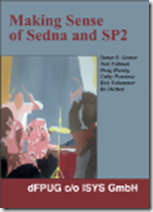
After a really long time in gestation, “Making Sense of Sedna and SP2” has finally been published by dFPUG in both English and German. This book, co-authored by Tamar E. Granor, Toni Feltman, Cathy Pountney, Rick Schummer, Bo Durban, and me, goes into tremendous depth on VFP 9 Service Pack 2 and Sedna, including installation gotchas, things that work, things that almost work, and how to make the use of the new features in both products. “Making Sense of Sedna and SP2” is available now from Hentzenwerke Publishing as an e-book and will be available in printed version in July.

makingsoscover100

Friday, May 14, 2010

New FoxShow

Good news, everyone (any Futurama fans out there?): Andrew MacNeill has a new FoxShow discussing integrating VFP and Silverlight with Uwe Habermann. Uwe and Venelina Jordanova are presenting several sessions on this topic at Southwest Fox 2010, including a free one-day post-conference workshop I’m sure will be very popular (I’m planning on attending it).

Performing Queries Asynchronously

VFP makes it easy to perform asynchronous queries against remote databases such as SQL Server. Why would you want to do that? With a synchronous query (the default), you have to wait until SQLEXEC() returns before you can execute any other code. What if you want to display the progress of record retrieval? What if you want to give the user the opportunity to stop a long query, especially if they realize they made a mistake and don’t want to wait a long time and retrieve a lot of records because of it? Asynchronous queries give you these abilities because execution returns to VFP after retrieving a configurable number of records.

You can switch to async mode any time, even after opening a connection, using SQLSETPROP(). You likely also want to configure how many records to retrieve at a time using CURSORSETPROP(). Here’s an example (this code assumes the connection handle is stored in lnHandle and lnAsyncRecords contains the number of records to retrieve):

sqlsetprop(lnHandle, 'Asynchronous', .T.)
cursorsetprop('FetchSize', lnAsyncRecords, 0)


You might also want to set the packet size; you may have to use trial and error to determine the optimum size for your network:


sqlsetprop(lnHandle, 'PacketSize', 12288)


When you’re in async mode, you have to retrieve records in a loop until either the query finishes or you decide to cancel it. You can tell when SQLEXEC() has completed because it returns a non-zero value; positive means it was successful, negative means it failed for some reason. You can also check to see how many records were retrieved on each pass by passing an array to SQLEXEC(); the second element in that array contains the number of records.


Here’s an example. This code assumes the SQL statement to execute is in lcSelect, the cursor to put the results into is in lcCursor, and the connection handle is in lnHandle. The commented area is where you’ll put code specific to your application to see if the user wants to cancel, such as if they click the Cancel button in a progress dialog you’ve displayed (such a dialog could also show the total number of records retrieved so far; that value is in lnCount). Once the loop is done, llReturn is .T. if the query succeeded, llCancelled is .T. if the user cancelled the process, and lnCount is the total number of records fetched (which of course you can also get from RECCOUNT(lcCursor)).


llDone      = .F.

lnCount     = 0

llCancelled = .F.
llReturn = .F.
do while not llDone
lnStatus = sqlexec(lnHandle, lcSelect, lcCursor, laInfo)
    if lnStatus <> 0
llDone   = .T.
        llReturn = lnStatus > 0
    endif lnStatus <> 0
    if laInfo[2] > 0
lnCount = lnCount + laInfo[2]
* see if user wants to cancel e.g. press Esc or click Cancel
* set llContinue to .F. if we’re supposed to cancel
        if not llContinue
sqlcancel(lnHandle)
            llDone      = .T.
            llReturn    = .F.
            llCancelled = .T.
        endif not llContinue
    endif laInfo[2] > 0
enddo while not llDone


There’s one caveat to this approach: some database engines don’t like it when you use SQLCANCEL() on the connection handle. With Pervasive, for example, the next time you use SQLEXEC(), you get an “invalid cursor state” error. The only solution in that case is to close and reopen the connection.


Fortunately, there’s a workaround for this. Rather than performing a query on the connection handle, use a new statement handle. To do that, start by making the connection handle sharable by passing .T. as the last parameter in SQLCONNECT() or SQLSTRINGCONNECT(). Then, just before starting the loop, get a new statement handle by calling SQLCONNECT() with the existing connection handle. In the following code, assume the connection handle is stored in lnConnectionHandle rather than in lnHandle:


lnHandle = sqlconnect(lnConnectionHandle)


Now SQLEXEC() is using a new statement handle shared from the original connection handle.


At the end of the loop, close the statement handle using SQLDISCONNECT(lnHandle); that doesn’t disconnect the connection, it just frees the resources used by the statement handle.

Tuesday, May 04, 2010

Southwest Fox 2010 News

Some exciting news about Southwest Fox 2010:

  • Speakers and sessions have been announced. Organizers once again had a very tough time selecting from the excellent submissions. I’m personally really looking forward to the Windows 7 sessions presented by Craig Boyd and Steve Ellenoff and Bo Durban’s Direct2D session. Actually, I want to see every session, but of course that’s not possible. Thank goodness one of the requirements of speaking at Southwest Fox is providing white papers so you still get the content from every session, even those you miss.
  • New this year is a Web Development track with seven regular sessions, two pre-conference sessions, and four post-conference sessions (see below) in this track alone.
  • We also have three new (well, new to Southwest Fox) speakers, continuing our tradition of trying to invite new speakers every year: Kevin Cully, Uwe Habermann, and Venelina Jordanova. Kevin is likely familiar to many people, as he has attended Southwest Fox before and hosted a conference himself a few years ago. Although Uwe and Venelina are new to North American conferences, they both are veteran speakers at European conferences, including both German and Prague DevCons.
  • A free one-day "VFP to Silverlight" workshop is being held the day after Southwest Fox ends (Monday, October 18), sponsored by the German FoxPro User Group (dFPUG) and presented by Uwe and Venelina. I’m planning on attending this and suspect it’ll be very popular.
  • Southwest Fox platinum sponsor Tomorrow's Solutions, LLC is offering a scholarship of $150 for one new attendee. Also, White Light Computing has changed their scholarship to cover TWO attendees this year.

See you in Phoenix in October!